

The Cleveland Plain Dealer, AI Panic, and Missing the Point
The backlash to the Plain Dealer's AI rewrite desk reveals an industry that's lost track of its own history — and lost the plot on its future.
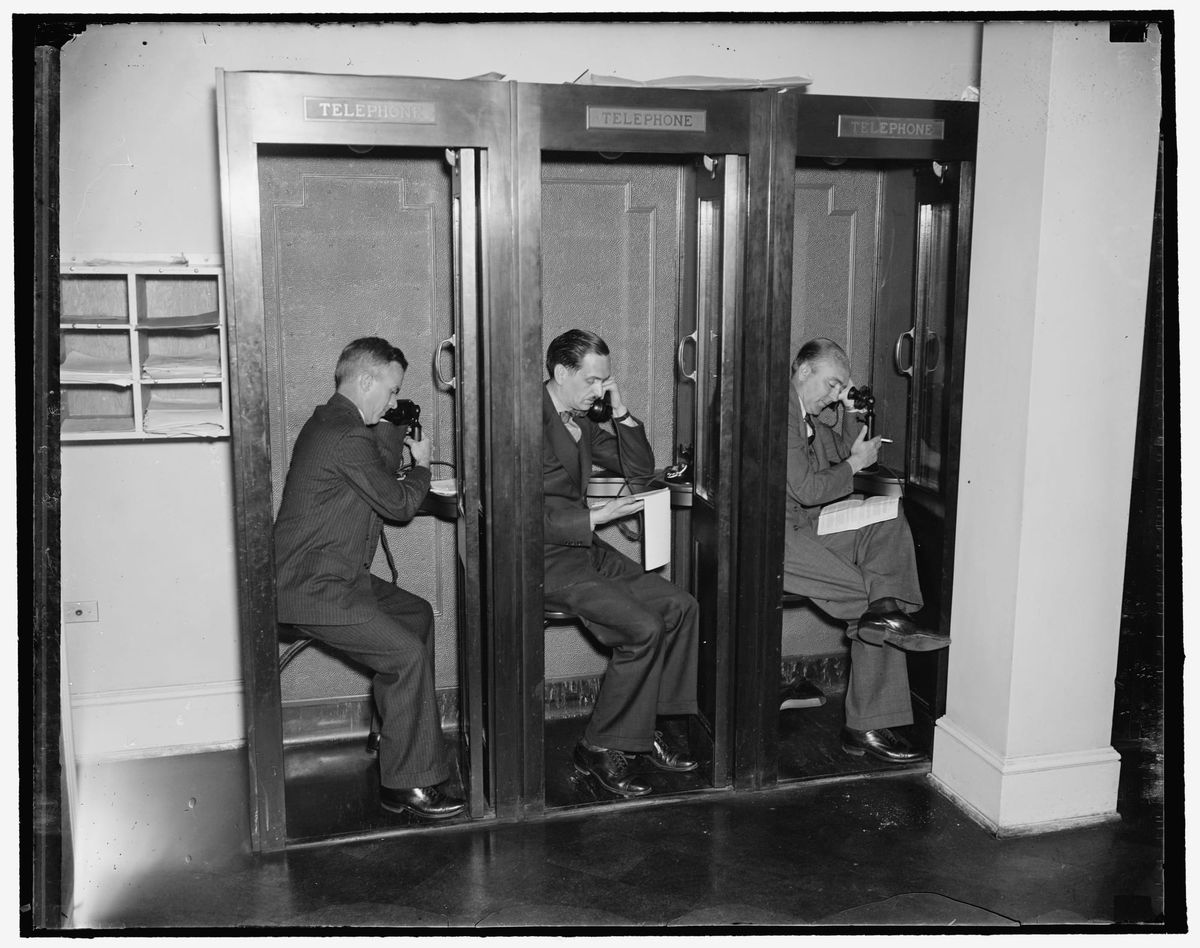
There’s a moment in Frank Capra’s 1939 film Mr. Smith Goes to Washington where, after something particularly memorable happens on the floor of the U.S. Senate, a gaggle of journalists rush from their perch above the proceedings to a bank of telephones. Notebooks and pencils clutched in their sweaty hands, they excitedly dictate reporting to a copy boy back in the newsroom. They have a deadline to meet — get this copy into the next edition!
That scene flashed in my memory this week while reading Cleveland Plain Dealer editor Chris Quinn’s column, published on February 14, scolding journalism schools and their recent graduates for being out of step and needlessly fearful of the AI era we’re slouching into. The Plain Dealer isn't a publication I usually read — as a native Pittsburgher, I’m legally prohibited from fraternizing with anything or anyone from Cleveland. This piece, though, was blasted into my feeds on a surge of performative LinkedIn rage posting.
In short: A college student, allegedly, withdrew from consideration for a role in the newsroom because, Quinn wrote, of the paper’s use of AI. The job, it seems, was all reporting. There was no writing involved because their work would be turned into copy by AI.
“Because we want reporters gathering information, these jobs are 100 percent reporting,” Quinn wrote. “We have an AI rewrite specialist who turns their material into drafts. We fact-check everything. Editors review it. Reporters get the final say. Humans — not AI — control every step.”
Cue the very reasonable takes.
Philip Lewis, a deputy editor at HuffPost, called the column "insulting" for its "anti-intellectualism."
"It is pretty pathetic, but also telling, that the editor of the Cleveland Plain Dealer — a once-respected newspaper — is encouraging the 'removing writing from reporters’ workloads,'" Lewis fumed. "Thinking and writing for yourself are key to a young journalist's development."
Journalist Will James, tapping into the deepening ocean of populist AI backlash, wrote that he's "not interested in what an AI thinks some median person would have written."
"[H]aving robots write for us means letting robots think for us. Every sentence we write is an analytical choice, an ethical choice, a human choice," added James, clearly missing some of the specifics of Quinn's piece. "Journalism is a public service and a creative discipline built upon connection between human beings. It is not a manufactured widget."
Let me be clear: AI cannot do a journalist’s job. Period. End of story. The machine can ingest a box score or council meeting minutes and spit out some kind of organized version of the facts, but it cannot handle the very human labor of talking with people, bringing empathy to a story, running down leads, following the money. James is right, journalism isn’t a widget — it’s a public service, and it should be treated with the respect and reverence that fact demands. To diminish that by throwing AI at the work and calling it a day would, indeed, be insulting and pathetic.
But that’s not what the Plain Dealer is doing here, at least as I read Quinn’s column. What he’s describing, it seems to me, is nothing more than a 21st century version of that scenario from Mr. Smith Goes to Washington — a rewrite desk for the AI era. But that might not be so apparent to those working in a profession that has lost track of its history — not because of technology, but because of money.
Jefferson Smith meets the Washington press corps
Once upon a time, the ink-stained wretches of newsrooms were blue collar workers with limited formal education. They could be hard-bitten, cynical, drunks, and reprobates — at least, that’s how journalists-turned-screenwriters like Ben Hecht and Budd Schulberg depicted their professional brethren — but the best of them were driven by some larger impulse to make sense of the world and the people in it, the forces working on the least of us and the minor miracles of the everyday lives of the trod upon. "You get a little picture that reflects the whole," Jimmy Breslin told Michael J. O’Neil. "You can get readers interested in the life of one guy, and he can reflect the whole life around him. And it's a better picture than the politicians give you." And to a man — and most were men — they started at the bottom, doing rewrites and fielding copy from other reporters and, if fortune shined, rushing to cover a fire that would appear as a short item in the next morning’s paper.
Post-Watergate, that all changed. Suddenly, credentials mattered. You couldn’t get in the door at some name-brand publications without a master’s degree from Columbia or Northwestern. You could skip all the entry-level steps and lead a beat — or at least see your byline early and often. And, increasingly, if you did get in, you needed some kind of independent income source to sustain in a major metropolitan area on a meager, shrinking salary. Suddenly, journalists became white collar, overeducated, out of touch. The current trust-in-media crisis didn’t come out of nowhere. But it could seem that way if you never knew poverty, didn’t have a military veteran in the family, weren’t a regular churchgoer.
With that shift, like in every industry, came alterations to how newsrooms worked. And as computers replaced typewriters and reporters’ pockets were filled with smartphones instead of quarters for payphones, out went the copy runners — those bottom-rung jobs where wannabe reporters took reporting from established bylines and fed them to rewrite desks. Being able to update copy in a CMS from any device anywhere made journalism frictionless. And it killed a job class in the process. Not that anyone seemed to notice.
But role definition isn’t the only thing that shrunk thanks to technology. Budgets collapsed due to an industry fundamentally unable to grapple with the internet. And with that came contracting newsrooms and fewer jobs and diminishing coverage areas. Finally, whole publications collapsed and disappeared. Hello, news deserts and the local news crisis.
AI is not the sole solution to anything, regardless of industry. But it can be one for a specific aim. In his 2020 book Newsmakers: Artificial Intelligence and the Future of Journalism, Francesco Marconi wrote about “iterative journalism,” by which machines will provide journalists with “more opportunities to go deeper into stories and actively connect with readers” while ensuring “the personal contributions of the journalist [remains] central to the process.”
“AI is just another tool in the journalistic toolbox that can strengthen its depth and breadth, just as the revolutions of the internet, telephone, and typewriter once did,” he continued. “Iterative journalism is not about ‘pivoting to AI’; it’s about surrounding human reporters with AI that can augment their abilities.”
This might look like feeding mountains of data into the machine and finding deeply buried connections and story ideas. Or it could mean reclaiming and expanding local coverage, which is what Quinn — again, taking him at his word — says the Plain Dealer is doing.
“Last year, we began covering Lorain, Lake and Geauga counties using powerful AI tools to help identify stories. The effort has been so successful we expanded it to Medina County this month,” Quinn wrote. “Most heartening, the experiment is proving the value of local journalism. Hannah Drown’s reporting in Lorain County has awakened residents, especially regarding a less-than-transparent county commission. People are paying attention and asking questions as never before.”
This sounds like a good first step to reclaiming journalism’s relevance and value — especially in communities that are otherwise overlooked, ignored, belittled, discarded. If AI is enabling that — and Quinn explicitly says that it is — I’m on board. With reservations. I’m a journalist, after all, and skepticism comes with the job. I’m skeptical of anyone who proclaims the AI jobpocalypse is mere months away. I’m skeptical of people who say AI is expensive vaporware. I’m skeptical of AI as a technology, generally. But I refuse to dismiss it out of hand because of some abstract fear that it’s going to decimate journalism. That’s not only short-sighted, it’s willfully ignorant of the very real forces actually, actively destroying journalism: venture capitalists, partisan FCC regulations, Google, Meta, and the industry’s addiction to display advertising.
The crime beat reporters swing into action in "His Girl Friday" (1940)
Let me be clear about something else: I love writing. Every journalist must write. And as American Press Institute executive director Robyn Tomlin said, “Writing is how journalists test their thinking and surface gaps in their reporting. When early-career reporters are denied the opportunity to write — and to struggle with writing — they lose a critical part of their professional formation.” That’s very true. But writing is more than synthesizing reporting and facts and words. Reporting is writing. Editing is writing. Being out in the world and simply observing is writing.
Something I’ve learned from my experience is that you can get by as a mediocre writer (if you have a good editor). You cannot hide, however, an inability to report, to research, to listen, to connect. If there is a paper willing to commit to offering the kind of real-world, on-the-ground experience in talking with people and information gathering that journalists once took for granted, we should be looking for ways to support — and replicate — that effort. And, anyway, the writing isn’t going away. Right, Chris Quinn?
The Plain Dealer editor could have saved himself a lot of grief if he had spent more time letting readers into just what this reporting experience is like for these early-career journalists instead of grinding his axe about journalism schools and how they’re failing students like the one who withdrew from consideration of the open role. What does the day-to-day experience for someone in that role look like? How are they engaging with AI and its output? How does the newsroom promote a culture of tech inclusivity? And so on.
There are systemic problems in journalism that AI is revealing. Seeing people grapple with them, in real time, is really something. But in this case, Quinn and the Plain Dealer seem to be doing something rare at a publication of its size: embracing a tech-forward attitude to innovate their way to maintaining relevancy and, better, encouraging growth.
Journalism is in bad shape. And there is no shortage of blame to go around. But instead of performative righteousness — you’re all very special journalists, can we move on? — let’s maybe stop trying to preserve an industry that no longer exists, accept that AI is here, commit to making it work for rather than against us, and then roll up our sleeves and get to building the journalism for this century. As Breslin was fond of saying, “journalism is a four letter word, W-O-R-K” — and there’s plenty of work to do.
Comments ()